



Sustainability
Risk Management
Basic Views
In the course of business operations, it is important to anticipate events that could occur in the future and to appropriately manage the likelihood of their occurrence and their potential impact. The Group identifies events with an unfavorable or negative impact on corporate management as risks and assesses them in terms of their probability of occurrence and impact. We are taking measures to prevent these risks under normal circumstances. Even if a risk materializes and a crisis occurs, we are hedging the risks in advance to minimize their negative impact and are prepared for a smooth transition to crisis management.
Risk Management System
The Company has established a Risk Management Committee to thoroughly and objectively identify various risks in the Group's management. This committee works to prevent risks and ensure quick and appropriate responses when they arise, driving and overseeing the risk management framework across the entire group.
Risk Management Committee
The Risk Management Committee reviews and decides on the following matters, and regularly reports the status of risk management to the Board of Directors, thereby ensuring the Board provides proper oversight.
- Establishing basic policies and regulations on management risks
- Identifying and assessing risks and reviewing the management framework
- Risk management awareness activities and training
Risk Identification Process
-
Risk identification
- Extracting risks from TOHO HOLDINGS, the pharmaceutical wholesaling business, the dispensing pharmacy business, and the pharmaceutical manufacturing and sales businesses
-
Risk assessment & prioritization (Mapping)
- Assessing and mapping risks based on the following criteria:
Frequency of occurrence: 1 (Extremely low) to 5 (Extremely high)
Anticipated level of impact: 1 (Minimal) to 5 (Severe)
- Assessing and mapping risks based on the following criteria:
-
Identification of material risks
-
Regular management by the Risk Management Committee
Anticipated level of impact
Large: Loss of operating profit of 1 billion yen or more
Medium: Loss of operating profit of 100 million to 1 billion yen
Small: Loss of operating profit of less than 100 million yen
Frequency of occurrence
High: Monthly to once every few months
Medium: Approximately once a year
Low: Once every few years
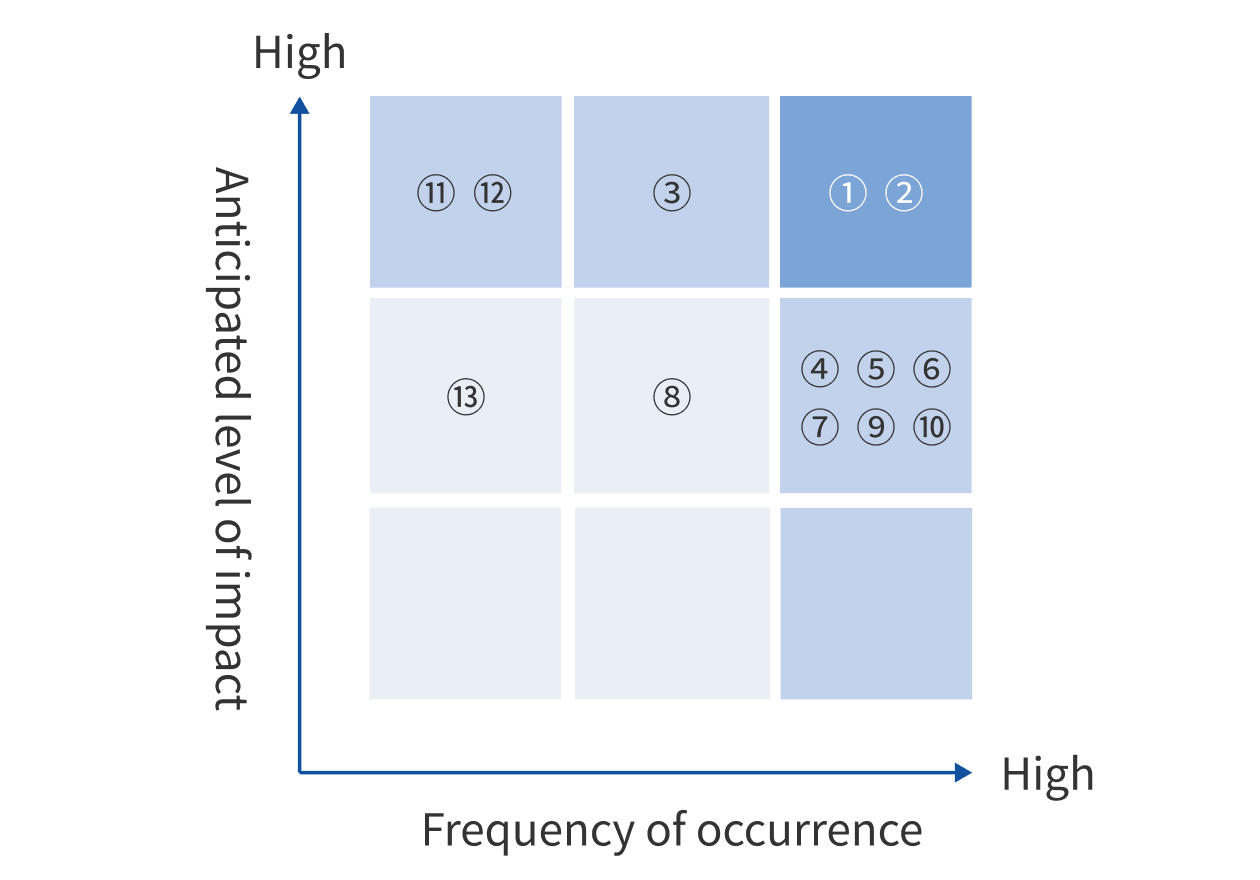
Material Risks of the Group
| Risk | Possible events | |
|---|---|---|
| ① | Market | Increased costs due to inflation and exchange rate fluctuations, difficulty in passing on prices, etc. |
| ② | Regulatory reforms | Changes in profit structure due to NHI drug price system revision, etc. |
| ③ | Medical safety | Dispensing errors, medical accidents, contamination with counterfeit drugs, etc. |
| ④ | Quality | Inadequate quality control of pharmaceuticals, etc. |
| ⑤ | Human capital | Difficulties in recruiting staff, reliance on specific individuals for tasks, an aging workforce, rising wage levels, etc. |
| ⑥ | Contracts | Inappropriate contract execution, failure to fulfill rights and obligations, etc. |
| ⑦ | Compliance | Violations of laws and regulations, harassment, internal misconduct, misconduct by business partners, etc. |
| ⑧ | Reputation | Scandals involving management, inappropriate posts on social media, etc. |
| ⑨ | Occupational safety and accidents | Breach of the duty of care, workplace accidents, traffic accidents, health problems, etc. |
| ⑩ | Credit | Credit instability, bankruptcy, bad debts, etc. of business partners |
| ⑪ | Stable supply and business continuity | Supply chain disruption, increased logistics costs, equipment failure, etc. |
| ⑫ | Natural disasters | Large-scale natural disasters, pandemics, and climate change, etc. |
| ⑬ | Information and cyber security | Cyberattacks, system failures, and information leaks, etc. |
Business Continuity Plan (BCP)
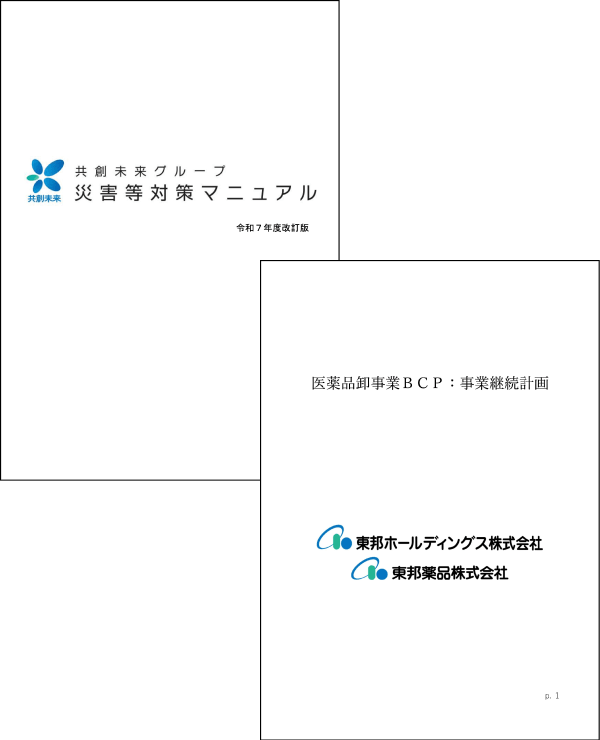
The Group has established a BCP to prepare for natural disasters.
Consistent BCP is required for drug distribution. Even when there is a natural disaster or an epidemic of infectious disease, we must deliver pharmaceuticals without delay. For this reason, the Group has developed BCPs based on various scenarios.
- Redundant host computer and warehouse management system
- Formulation of the BCP (Business Continuity Plan) Document for the pharmaceutical wholesaling business
- Formulation of the Kyoso Mirai Group Disaster Countermeasures Manual (revised in 2021)
- Establishment of the Kyoso Mirai Group Disaster Countermeasures Committee and holding of regular meetings
- Installation of in-house power generation facilities
- Deployment of emergency motorcycles
- Installation of disaster priority phones, satellite phones, etc.
- Utilization of advance notification system for emergency vehicles
- Introduction of safety confirmation system