






Sustainability
Corporate Governance
Basic Views
The Company and the Group are committed to enhancing the corporate governance as one of the most important managerial tasks, because we recognize that it is important to enhance the auditing and supervisory functions concerning corporate management, achieve full compliance, and improve the transparency of management so that we can sincerely fulfill our responsibilities towards various stakeholders, including customers, business partners, shareholders, employees, and government entities, and enhance our corporate value as sustainable companies.
Governance System
Overview of current corporate governance system
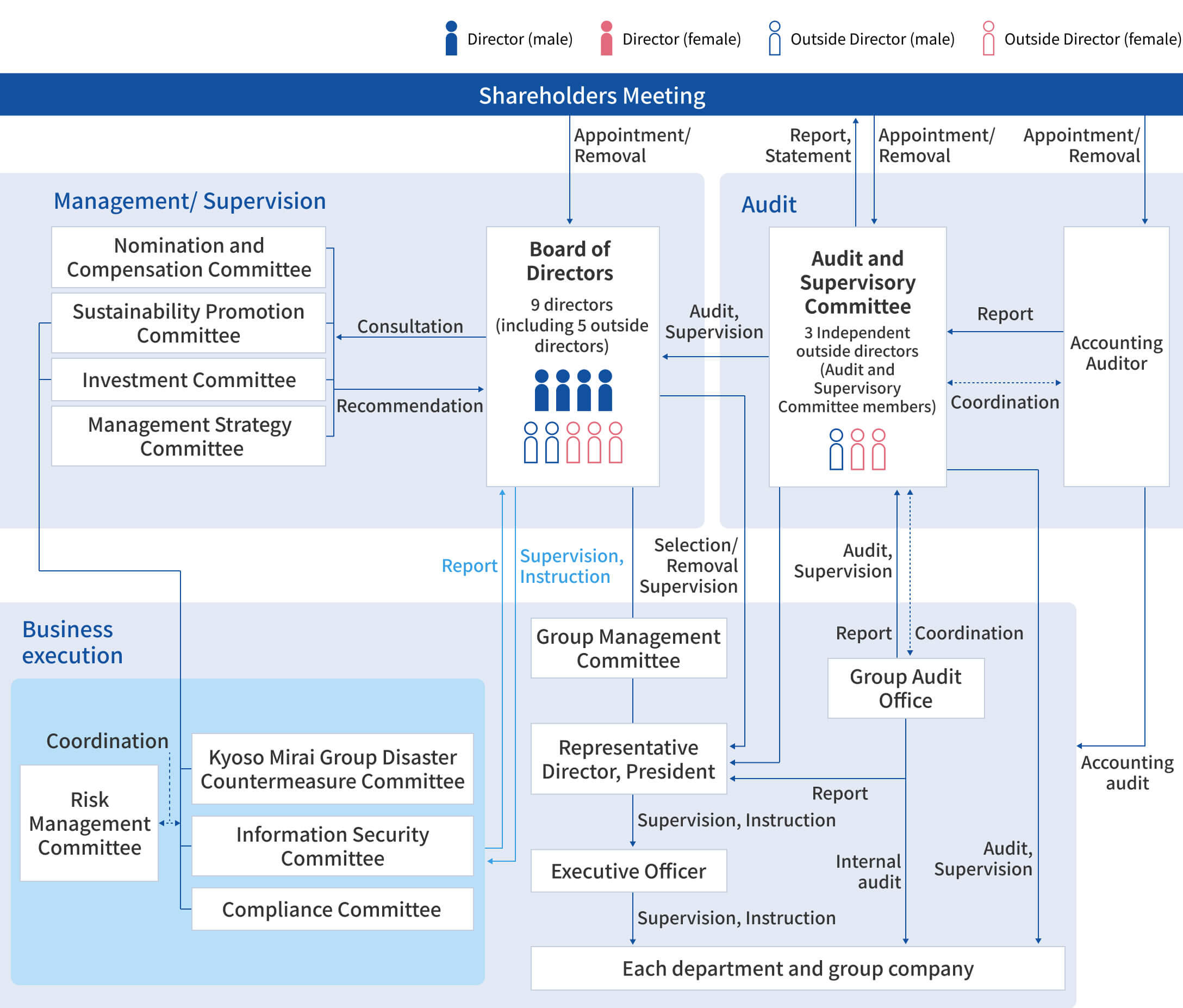
The Company has adopted an Audit and Supervisory Committee governance structure from the perspective of further enhancing corporate governance by strengthening the supervisory functions of the Board of Directors, thereby promoting the improvement of the corporate value on a mid-to long-term basis through the enhancement of the functions of outside directors who do not execute operations by themselves.
You can swipe to view
Board of Directors / Audit and Supervisory Committee / Nomination and Compensation Committee
Board of Directors
The Company's Board of Directors consists of nine directors. To incorporate independent and objective perspectives, five of these are outside directors (including three Audit and Supervisory Committee Members), thereby strengthening the Board of Directors’ oversight function. Drawing on their respective expertise and experience, the directors engage in lively discussions, make legal and managerial decisions, and supervise the effective execution of business operations.
In FY2025, the Board of Directors held 13 meetings to discuss management strategies, including the Medium-term Management Plan and action plans, as well as the structure of the governance framework, encompassing compliance and risk management, and received reports on the activities of various committees, dialogue with investors, and other matters.
Audit and Supervisory Committee
The Audit and Supervisory Committee hears reports from directors and other officers regarding the status of business operations and reviews important decision-making documents and other materials. Directors who are Audit and Supervisory Committee Members strive to conduct rigorous audits by investigating the status of operations and assets in accordance with audit policies and the division of responsibilities.
Members of the Committee (As of June 26, 2026)
| Outside Director (Audit and Supervisory Committee Member) |
Chie Goto (Chair) |
|---|---|
| Outside Director (Audit and Supervisory Committee Member) |
Hidehito Kotani |
| Outside Director (Audit and Supervisory Committee Member) |
Miho Saito |
Nomination and Compensation Committee
In order to strengthen the transparency and objectivity, the Company has established the voluntary Nomination and Compensation Committee as an advisory committee to the Board of Directors. The Committee is chaired by an outside director and the majority of its members are independent outside directors.
Members of the Committee (As of June 26, 2026)
| Outside Director (Audit and Supervisory Committee Member) |
Hidehito Kotani (Chair) |
|---|---|
| Representative Director, President and CEO | Hiromi Edahiro |
| Outside Director (Audit and Supervisory Committee Member) |
Chie Goto |
| Outside Director | Manako Haga |
| Outside Director | Masahiko Ito |
Committees
Group’s Management Committee
In order to realize efficient decision making at meetings of the Board of Directors, the Company has established the Group Management Committee as an organization tasked with deliberating in advance the proposals that are to be submitted to the Board of Directors, and holds regular meetings every month. The Company ensures the proper execution of operations by thoroughly deliberating on relevant issues at this Group Management Committee.
Investment Committee
The Company has in place the Investment Committee, an advisory committee to the Board of Directors, to examine investment proposals before selecting them. The Investment Committee is comprised of members from finance, legal, sales, pharmaceutical affairs, and other divisions as well as of external experts. It is chaired by the Executive Corporate Officer and CFO (Head of Administration Division).
Sustainability Promotion Committee
The Company has established the Sustainability Promotion Committee as an advisory committee to the Board of Directors. The Committee is responsible for identifying materiality (important issues), including matters related to climate change, and deliberates on our sustainability strategy, which involves, among other things, our actions for the Environment (E), Social (S), Governance (G), digital transformation (DX); and conducting action planning, target setting, progress control, and effectiveness assessment based on the Sustainability Policy. The Committee is comprised of members from sales, logistics, pharmaceutical affairs, and administration functions. It is chaired by the Senior Executive Managing Director and COO.
Management Strategy Committee
The Company has established the Management Strategy Committee as an advisory body to the Board of Directors to deliberate on important management and business strategies concerning the Company and the Group, evaluate the initiatives set forth in the Medium-term Management Plan, and consider measures to address identified issues. The Management Strategy Committee is composed of not only inside directors and corporate officers, but also independent outside directors and outside experts in order to fully leverage external perspectives.
Evaluation of the Effectiveness of the Board of Directors
To enhance the functioning and operations of the Board of Directors, the Company conducts an annual survey of all directors on its effectiveness.
In fiscal 2025, to ensure the objectivity and transparency of the evaluation, the Company conducted a third-party assessment with the assistance of an external organization. Based on the results, the Board of Directors has discussed and confirmed the challenges and items to be addressed.
Evaluation of the effectiveness of the Board of Directors for FY2025
Evaluation Method
- Conducting an anonymous survey with the assistance of an external organization, including open-ended sections for specific opinions and proposals
- Conducting individual interviews with all directors by the external organization based on the survey results
- Aggregating, analyzing, and evaluating the results of the questionnaire and interviews by the external organization
Survey Items
- Role and responsibilities of the Board of Directors
- Composition of the Board of Directors
- Operation of the Board of Directors
- Management strategy and business plans
- Internal control and risk management
- Nomination and compensation
- Performance of outside directors
- Support system for directors
- Training
- Dialogue with shareholders and investors
- Each director’s efforts
- Evaluation of the Nomination and Compensation Committee
- Evaluation of the Audit and Supervisory Committee
- Summary
Status of Initiatives Addressing Issues Identified in the Fiscal 2024 Effectiveness Evaluation
① Further revitalizing medium- to long-term and strategic discussions
- Set key themes requiring deeper discussion from a medium- to long-term and strategic perspective as annual agendas for the Board of Directors
- Extended Board meeting times and adjusted time allocations based on the importance of each agenda item to ensure substantial discussions
② Expanding training opportunities
- Provided training opportunities on a diverse range of topics, including holding training sessions led by external instructors and utilizing courses provided by external organizations
③ Earlier submission of meeting materials
- Commenced operations utilizing DX tools to secure sufficient time for directors to review each proposal
- Continued to provide briefing sessions in advance for major proposals, enabling directors to fully grasp the details of the items beforehand
Evaluation Results
Based on the results of the survey and interviews, the Company confirmed that the effectiveness of the Board of Directors as a whole has been ensured and that it functions appropriately. While positive evaluations were received regarding the Board's composition (skills and expertise), outside directors' performance, dialogue with shareholders and investors, and the open discussions within the Nomination and Compensation Committee, the need to review the criteria for matters brought before the Board was recognized as an issue in order to focus further on medium- to long-term and strategic discussions. In addition, ensuring executive training opportunities was shared as an issue to be addressed on an ongoing basis moving forward.
Future initiatives
Based on the results of this effectiveness evaluation, the Company will implement the following initiatives to further improve the effectiveness of the Board of Directors.
- Reviewing the Board submission and reporting criteria to further enrich discussions on key themes, such as management strategy
- Providing ongoing training opportunities on a variety of topics
Nomination of Directors
Director Appointment Process
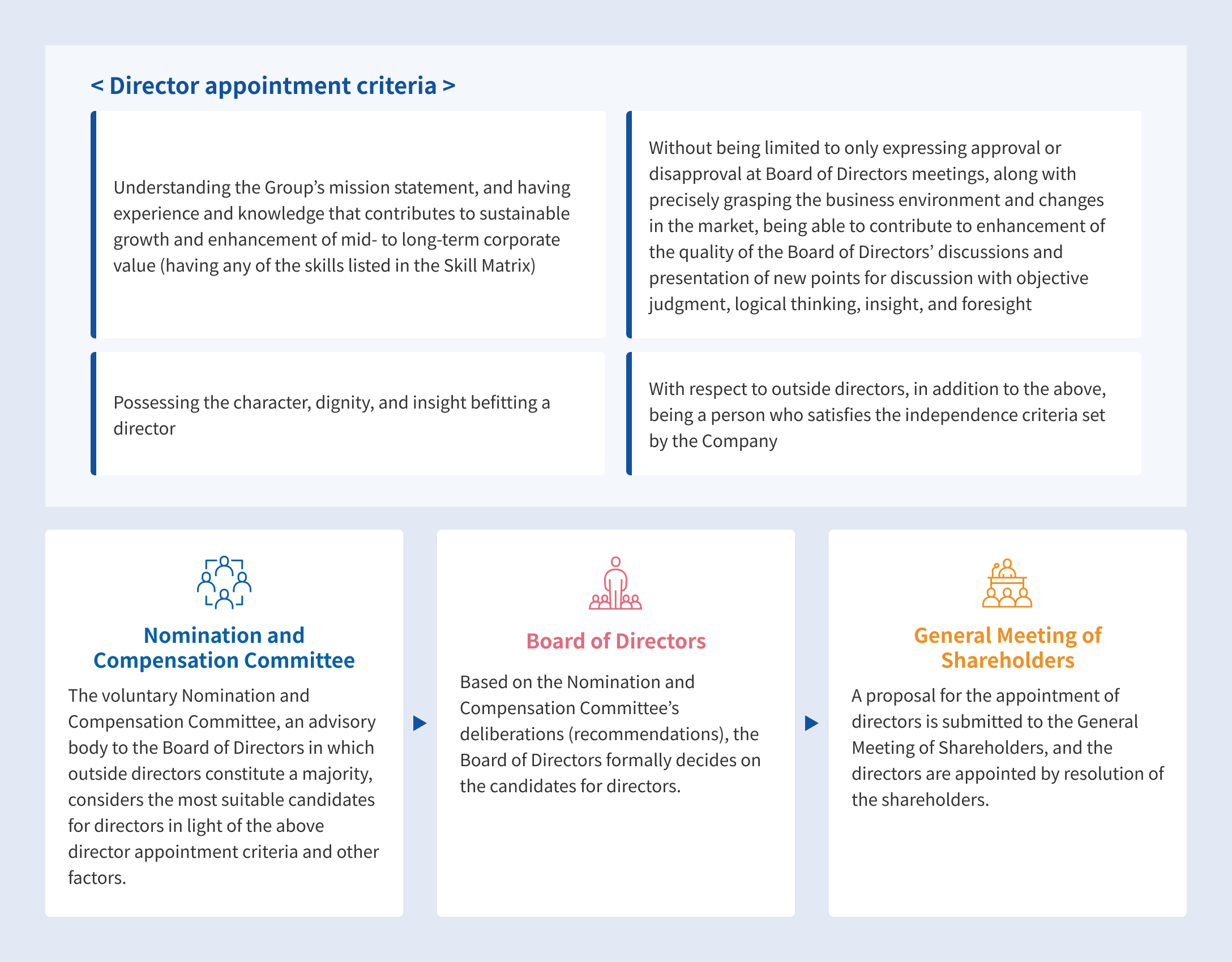
Nominations of candidates for directors are deliberated in advance by the voluntary Nomination and Compensation Committee, which is an advisory to the Board of Directors and a majority of whose members are outside directors, and are resolved by the Board of Directors.
In selecting directors, the Company comprehensively considers their understanding of its business, diverse perspectives that contribute to improving the effectiveness of the Board of Directors, their expertise and experience, and other factors, expecting them to contribute to the sustainable growth of the Group and the enhancement of corporate value over the medium to long term.
You can swipe to view
The Concept of Diversity of Board of Directors
The Company’s Board of Directors strives to ensure diversity in terms of gender, age, work experience, etc. in order to facilitate discussions from diverse perspectives.
Furthermore, in anticipation of their contribution to the Group's sustainable growth and enhancement of corporate value over the medium to long term, the Company has appointed as board members four inside directors and five outside directors (including three women) with not only an understanding of its business but also a wide range of expertise and abundant experience in corporate management, the pharmaceutical industry, finance / accounting / capital markets, legal affairs, business development / DX, sustainability, etc. to ensure a well-balanced composition that contributes to enhancing the effectiveness of the Board of Directors.
Criteria for Judging Independence of Outside Directors
The Company has established “Independence criteria for outside directors” as set forth below, and it judges outside directors or candidates to be an outside director who do not fall under any of the following items to have independence.
-
An executive (Note 1) of the Company or its subsidiaries (the “Group”), or a person who was an executive of the Group within the past ten years
-
A major shareholder (Note 2) of the Company, or an executive thereof
-
A main business partner of the Group (Note 3), or an executive thereof
-
A party that has the Group as its main business partner (Note 4), or an executive thereof
-
A main lender of the Group (Note 5), or an executive thereof
-
An executive of the Group’s lead underwriter
-
An individual belonging to an audit firm that is the Group’s accounting auditor
-
A consultant, accounting professional, or legal professional (if such a party is a corporation, partnership, or other organization, a person belonging to such organization) who has received from the Group on average over the most recent three business years money or other property of at least 10 million yen per year other than as officer compensation
-
A person who on average over the most recent three business years has received from the Group donations or aid of at least 10 million yen per year or at least two percent of their annual gross income amount; if the recipient of such donations or aid is a corporation, partnership, or other organization, an executive of such organization
-
A business that accepts a director or Auditor from the Group, or an executive of that business group
-
A person for whom less than five years have passed after leaving a past position at an organization or business partner set forth in 2 through 9 above
-
A spouse or a relative in the second degree of kinship of a person listed in 1 through 11 above (however, limited to key persons (Note 6))
-
A person whose total period in office as an outside director exceeds ten years
- Note 1: Executive refers to an Executive Director, Corporate Officer, another person corresponding thereto, or employee.
- Note 2: Major shareholder refers to someone who holds no less than ten percent of all voting rights at the end of the most recent business year.
- Note 3: A main business partner of the Group refers to a business partner whose annual transaction amount exceeds one percent of the Company’s consolidated sales in the most recent business year.
- Note 4: A party that has the Group as its main business partner refers to a party whose annual transaction amount with the Company Group exceeds one percent of that business partner’s consolidated sales in the most recent business year.
- Note 5: Main lender of the Group refers to a financial institution that has lent to the Group an amount that exceeds one percent of the Company’s consolidated total assets in the most recent business year.
- Note 6: Key person refers to Directors, Corporate Officers, and executives who are ranked at or above General Manager
Succession Plan
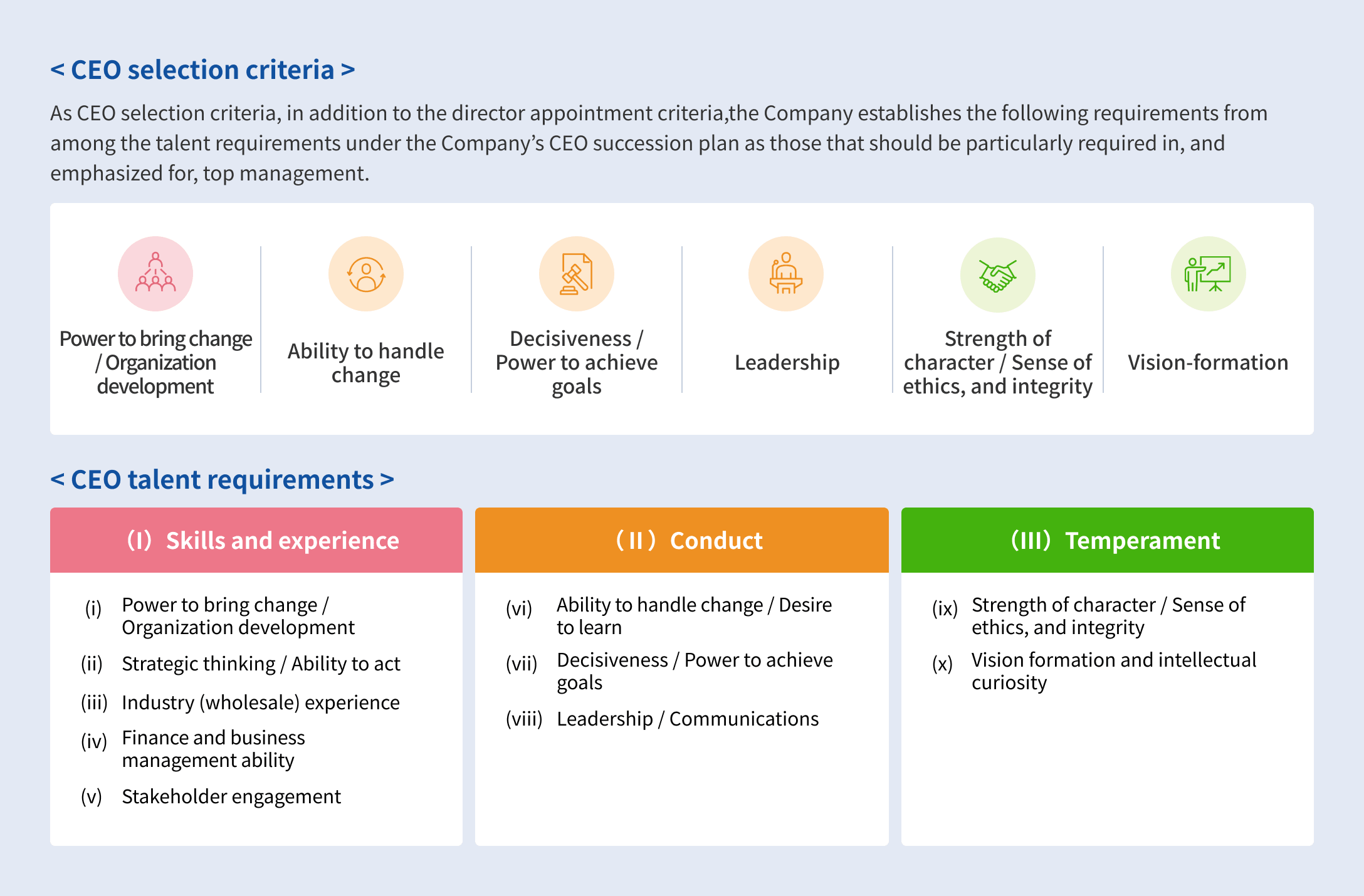
To achieve the Group’s sustainable growth and enhance its corporate value over the medium to long term, the Company has formulated and is implementing a succession plan to continuously identify and develop top management and executive candidates who will lead the next generation.
The Nomination and Compensation Committee, in which independent outside directors constitute a majority, considers the definition of human resource requirements, selection of candidates, and specific development programs under the succession plan.
CEO Talent Requirements and Selection Criteria
You can swipe to view
Compensation for Directors
Basic Views
- Compensation shall be determined based on fair and reasonable standards, comprehensively considering the duties of directors, degree of responsibility, contribution to business performance, etc.
- Compensation shall be an appropriate combination of fixed compensation (base compensation), performance-linked compensation, stock compensation, etc., from the perspective of improving the Company’s corporate value over the medium to long term.
- The content of compensation shall be highly independent, transparent, objective, and accountable to the Company’s stakeholders.
Compensation Levels
- The compensation levels shall be determined by resolution of the Board of Directors after the Nomination and Compensation Committee verifies the appropriateness thereof by conducting research and analysis of compensation levels for each position using data from an external research organization and peer groups of companies with more or less the same market capitalization or companies in similar industries.
- The compensation levels shall be reviewed from time to time in accordance with changes in the Company’s business environment and external environment.
Composition of Compensation
- Compensation for directors (excluding outside directors) shall be divided into three categories: representative salary, supervisory salary, and executive salary. Outside directors shall be paid only fixed compensation in light of their duties.
| Representative salary | A fixed amount of money is paid monthly to Directors with representative authority. | |
|---|---|---|
| Supervisory salary | A fixed amount of money is paid monthly as compensation for management supervision. | |
| Executive salary | Fixed compensation, performance-linked bonus (STI), and stock compensation (LTI) shall be paid for business execution. The composition of executive salary shall be 65–75% fixed compensation, 15–20% bonus, and 10–15% stock compensation. | |
| Fixed compensation |
|
|
| Bonus (STI) |
|
|
| Stock compensation (LTI) |
|
|
Matters concerning the determination of the content of compensation, etc. for individual Directors
Compensation for individual Directors (excluding those who are Audit and Supervisory Committee Members) shall be determined by the Board of Directors after deliberation by the Nomination and Compensation Committee. In the event of revision of the determination policy, the details shall be deliberated by the Nomination and Compensation Committee prior to the resolution of the Board of Directors.
Total amount of compensation, etc. to Directors for FY2025
| Director category | Total amount of compensation, etc. (million yen) | Total amount of compensation, etc., by type (million yen) |
Number of eligible directors | ||
|---|---|---|---|---|---|
| Fixed compensation | Performance-linked compensation | Restricted stock | |||
| Directors (excluding those who are Audit and Supervisory Committee Members) (of which outside directors) |
258 (9) |
201 (9) |
30 (-) |
27 (-) |
7 (1) |
| Directors who are Audit and Supervisory Committee Members (of which, outside directors) | 63 (63) |
63 (63) |
- (-) |
- (-) |
4 (4) |
| Total (of which, outside directors) | 321 (72) |
264 (72) |
30 (-) |
27 (-) |
11 (5) |
- * The table above includes two (2) Directors (excluding those who are Audit and Supervisory Committee Members) who resigned at the conclusion of the 77th Annual General Meeting of Shareholders held on June 27, 2025.
Cross-shareholdings
Comprehensively taking into account a management strategy, building, maintenance, and strengthening of relations with business connections, and other matters, the Company holds shares that it finds contribute to enhancing the Group’s corporate value from a medium- to long-term point of view.
The Company regularly reviews the appropriateness of holding those shares by carefully examining whether the benefits of holding each company’s shares align with the Company’s policy and selling any shares deemed inappropriate to retain.
Status of cross-shareholdings
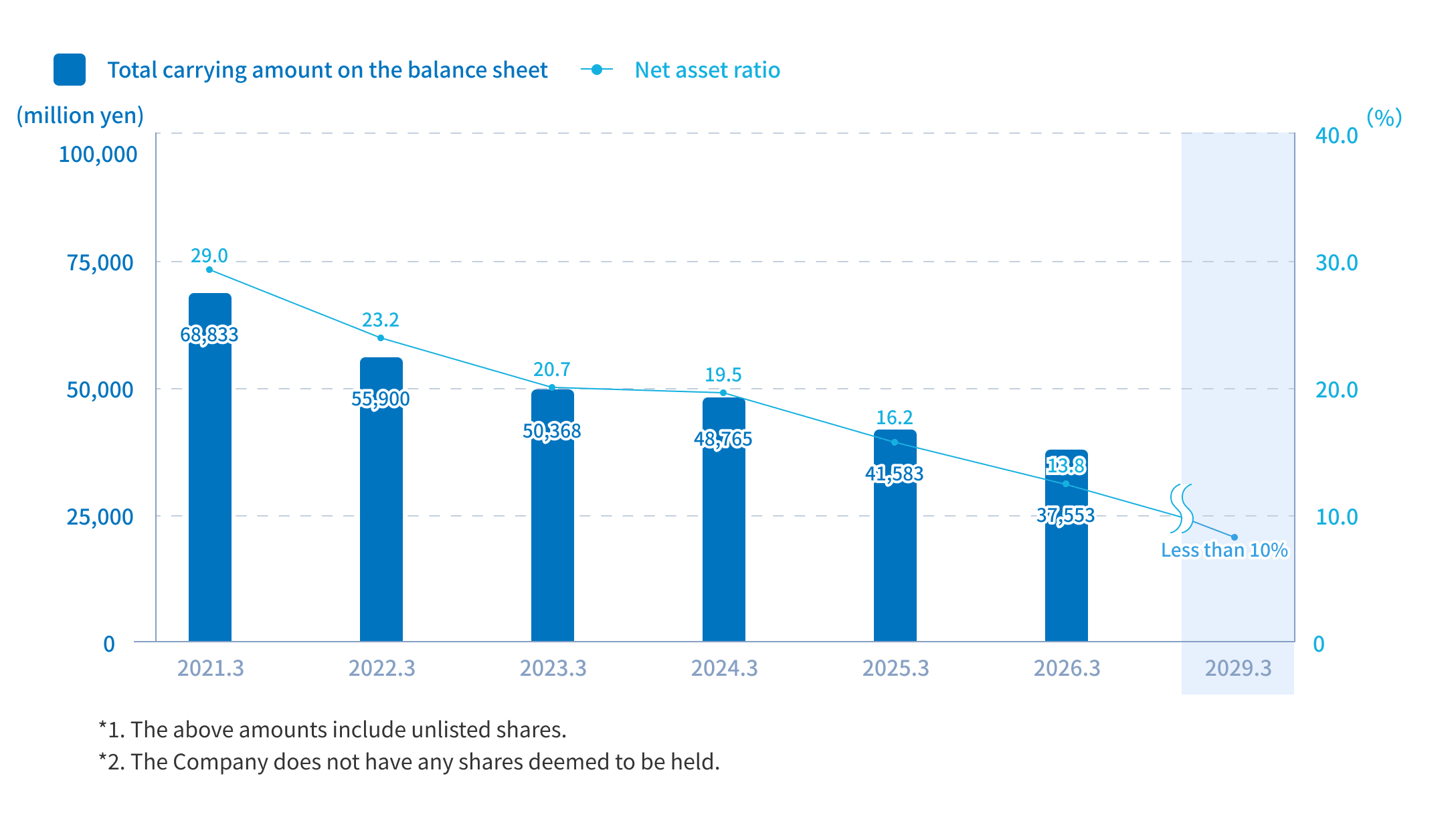
The Company has been steadily reducing our cross-shareholdings after thorough discussions with the companies involved. In FY2025, we sold 10 stocks (totaling 14,282 million yen). This reduced the ratio of cross-shareholdings to net assets to 13.8%.
You can swipe to view
Changes in the number of stocks and amounts of cross-shareholdings sold
| Fiscal Year | Number of stocks sold | Amounts of shares sold (million yen) |
|---|---|---|
| 2021.3 | 16 | 7,391 |
| 2022.3 | 15 | 5,195 |
| 2023.3 | 12 | 5,808 |
| 2024.3 | 12 | 13,188 |
| 2025.3 | 4 | 7,923 |
| 2026.3 | 10 | 14,282 |
- * Including a partial sale.
Internal Control System
Basic policy on internal control system
Basic Views on Internal Control System and the Progress of System Development
According to the provisions of the Companies Act, the Company has set up its “Basic policy on internal control system” and faithfully carries out this policy in order to ensure the legality and efficiency of the Company’s business operations and undertake risk management practices. Moreover, the Company reviews its basic policy in a timely manner, according to changes in the socioeconomic climate and other aspects of the environment surrounding the Company, and further improves and enhances its basic policy.
Basic views on internal control system and the progress of system development
Corporate Governance Report (Last Update: July 8, 2026)