





Sustainability
Responding to Climate Change
The Group has positioned efforts to address climate change as one of its key issues, and the Sustainability Promotion Committee is playing a central role in identifying climate change-related risks and opportunities, assessing their impact on the Group, and considering specific measures to deal with them. The necessary data are being collected and analyzed, and the Group will promote disclosure in accordance with the information disclosure framework (governance, strategy, risk management, and metrics and targets regarding climate change risks and opportunities) recommended by the Task Force on Climate-related Financial Disclosures (TCFD)*.
In disclosing information in accordance with the TCFD recommendations, the Group refers primarily to the following scenarios:
- Transition Risk and Opportunities "1.5 ℃ scenario": International Energy Agency (IEA) WEO2020 NZE
- Physical Risks and Opportunities "4 ℃ scenario": Intergovernmental Panel on Climate Change (IPCC) AR5
- *TCFD: Task Force on Climate-related Financial Disclosures; The Group expressed its endorsement of the TCFD recommendations on June 9, 2023.

Items recommended for disclosure by TCFD recommendations
In line with the TCFD recommendations, the Group discloses climate information related to four topics.
Governance
Organization's governance around climate-related risks and opportunities
Strategy
The actual and potential impacts of climate-related risks and opportunities on the organization’s businesses, strategy, and financial planning
Risk management
The processes used by the organization to identify, assess, and manage climate-related risks
Metrics and targets
Metrics and targets used to assess and manage relevant climate-related risks and opportunities
1. Governance
The Group recognizes climate-related action as one of our key managerial priorities. For this action, The Group has a corporate governance system in place with the Sustainability Promotion Committee playing a central role, subject to supervision by the Board of Directors.
Divisions and Departments Responsible for Climate Action
The Corporate Strategy Division serves as the secretariat for the Sustainability Promotion Committee. It also serves as a liaison among the divisions and departments concerned and promotes company-wide climate action. Additionally, the Division formulates the Group's sustainability strategy, which covers, among other things, matters related to climate change, and advises the Sustainability Promotion Committee.
2. Strategy
The Group recognizes sustainability action, including climate action, as one of its key managerial priorities. Supply-chain disruptions and reduced capacities to supply drugs due to intensifying natural disasters pose a significant business risk for the Group – an entity responsible for the distribution of vital and other drugs. They also pose a risk for society at large. Due to the nature of the business, the emission volume of the Group is characterized by low Scopes 1 and 2 emissions (emissions released directly from it) and high Scope 3 emissions (emissions released from its supply chains). With this understanding, the Group has conducted a scenario analysis to assess climate impacts on our business and devise measures to cope with them.
For this analysis, the Group referred to scenarios in the IPCC Fifth Assessment Report and IEA WEO2020 NZE, among others. It then considered both a 1.5 ℃ scenario – in which the global temperature rise will be limited to 1.5 ℃ by 2030 (transition scenario) – and a 4 ℃ scenario – in which the global temperature will rise 4 ℃ by 2050 (physical scenario). This analysis covers the pharmaceutical wholesaling business.
Global Outlooks Assumed under the 1.5 ℃ and 4 ℃ scenarios
1.5 ℃ scenario (transition scenario)
Global outlook
Environmental regulations and technological advances reduce carbon emissions, thereby keeping greenhouse gas (GHG) emissions in check. Environmental regulations mean the need to facilitate more use of non-fossil energy.
Policy and legal
Stricter laws and regulations
Fossil energy use
Minimum use
Non-fossil energy use
Aggressive deployment
Regulations and institution
- The introduction of a carbon tax increases the tax burden with regard to carbon emissions (CO2 emissions)
- Electricity prices rise due to promotion of more use of renewable energy sources (renewables)
- Energy efficiency subsidies (various support measures) are available
- Rapid emissions reduction is required toward carbon neutrality by 2050
Market
- Naphtha prices go up owing to lower gasoline demand
- Increased adoption of renewables reduces the use of fossil-derived energy
- The introduction of EVs and other low-carbon delivery means accelerates
- The addition of carbon taxes and the cost of procuring renewables pushes up the cost of goods
- Changes to the power mix and the impact of carbon prices increase the unit price of electricity
- The impact of carbon prices and soaring prices of fossil-derived energy increase delivery costs
Technology
- Emergence of decarbonization technologies
- Rise of non-fossil materials
Reputation
- Cooperation with local communities in disaster response becomes more important
- ESG investment takes root
- Requests from stakeholders to reduce GHG emissions increase
- ESG compliance is added as criterion for selecting business partners
4 ℃ scenario (physical scenario)
Global outlook
No new policies or regulations for curbing temperature rises are implemented or encouraged, resulting in high greenhouse gas (GHG) emissions. This in turn leads to more natural disasters, thereby making it necessary to defray the costs of capital investment aimed at strengthening disaster prevention capabilities.
Policy and legal
Existing laws and regulations remain unchanged
Fossil energy use
Remain unchanged
Non-fossil energy use
Remain unchanged
Acute
- Extreme weather events (torrential rains, typhoons, high tides, floods, wildfires) intensify
- Rising temperatures increase the burden on air conditioning (power consumption)
- Changes to the power mix push up electricity prices
- Little progress in renewable deployment sends gasoline prices higher
- Storms and floods disrupt transport networks
Chronic
- Mean temperatures rise
- Average sea level rise
- Water resources deplete due to droughts
- Nature-derived materials face shortages due to changing climate conditions
- Infectious diseases increase due to environmental changes
- Handling products that need temperature control such as prescription pharmaceuticals becomes more difficult
Identification of Risks and Opportunities
The table below summarizes possible climate-induced events in light of the analyzed scenarios by identifying risks and opportunities with high impact and evaluating the influence on business and financials from both quantitative and qualitative aspects. The Sustainability Promotion Committee will conduct a quantitative assessment, including financial impact, while considering the resilience of the Group's strategy and the necessity to develop a transition plan.
Risk
| Category | Classification | Risks | Financial Impact (*1) | Method of calculating impact | Time frames (*2) | |
|---|---|---|---|---|---|---|
| FY2030 | FY2050 | |||||
| Transition (1.5 ℃ scenario) | Carbon tax | Increases in distribution and operational costs at stores, sales offices, logistics centers, etc., due to the introduction of a carbon tax (The impact of a carbon tax on the supplier’s purchase cost is not taken into account, since the cost is related to the drug pricing system) |
Medium (About 0.6 B yen) |
Large (About 1.1 B yen) |
Calculated based on greenhouse gas (GHG) emissions in FY 2023 and IEA emission factors | Medium to long term |
| Energy | Increase in business operating costs such as storage and distribution of pharmaceuticals at stores, sales offices, logistics centers, etc., due to rising energy prices | Large (About 1.3 B yen) |
Large (About 1.1 B yen) |
Calculated based on energy consumption in FY 2023 and IEA emission factors | Medium to long term | |
| Increase in procurement costs due to higher costs at suppliers being passed on to purchase prices | Large* | Large* | ー | Medium to long term | ||
| Technology | Increase in capital investment costs due to the strengthening of decarbonization-related policies, laws and regulations, energy conservation measures, and the introduction of decarbonization equipment | Large | Large | Calculated based on the investment amount for energy conservation | Medium to long term | |
| Reputation | Decline in stakeholder evaluation and impact on stock price and business performance due to delay in climate change measures | Large* | Large* | ー | Medium to long term | |
| Physical (4 ℃ scenario) | Acute | Increase in operational costs associated with suspension of operations at stores, sales offices, and logistics centers due to the increased frequency and intensity of storms and floods | Large | Large | Assuming shutdown of offices and loss of all inventory | Short to medium term |
| Decline in business performance due to a shortage of employees (difficulty of employees coming to work) and patients’ reluctance to seek care owing to the spread of infectious diseases (pandemic) | Small* | Small* | - | Medium to long term | ||
| Impact on stable supply due to inability to procure pharmaceuticals, etc., caused by suspension of supplier operations | Large | Large | Assuming that major manufacturers will be damaged and recovery will take some time | Medium to long term | ||
| Chronic | Increases in operational costs for pharmaceutical quality control due to rising temperatures | Large (About 1.6 B yen) |
Large (About 1.5 B yen) |
Calculated based on FY 2023 energy consumption and IEA parameters | Medium to long term | |
| Increases in costs for improvement of workplace environments and business operations at business site due to rising temperatures | Large | Large | Calculated based on FY 2023 energy consumption and IEA parameters | Medium to long term | ||
| Decline in business performance due to suspension of operations and reduction of production volume at suppliers. | Large | Large | Assuming that major manufacturers will be damaged and recovery will take some time | Medium to long term | ||
Opportunities
| Risks | Financial Impact (*1) | Time frames (*2) | |
|---|---|---|---|
| FY2030 | FY2050 | ||
| Improvement in business performance and higher stock prices due to higher evaluation by stakeholders as a result of taking action on climate change | Medium* | Medium* | Short to medium term |
| Improvement in business performance due to increased demand for related pharmaceuticals caused by the spread of infectious diseases (pandemics) | Medium* | Medium* | Medium to long term |
| Increase in demand for related products and services as climate change drives demand for new medical care provision system | Small* | Small* | Short to medium term |
| Creation of new business opportunities as climate change drives demand for new medical care provision system | Medium* | Medium* | Short to medium to long term |
- *1. The evaluation criteria for impact are based on the impact on operating profit. Large: 1 billion yen or more, Medium: 0.5 billion yen to less than 1 billion yen, Small: less than 0.5 billion yen
Items for which quantitative evaluation is difficult are evaluated qualitatively (*) - *2. The time frame is set at short term (to FY2025), medium term (to FY2030), and long term (to FY2050)
3.Risk Management
Regarding risks related to climate change, the Sustainability Promotion Committee identifies and assesses risks and opportunities, considers countermeasures, sets targets, and reports to the Board of Directors periodically.
Process for Identifying, Assessing, and Managing Risks Related to Climate Change
The process for identifying, assessing, and managing risks related to climate change involves the following steps:
-
Risk identification
The Group identifies the impacts of climate change on its business as well as the risks of natural disasters and the social and other problems that may be caused by climate change. Information on climate-related risks thus identified is shared with the Risk Management Committee and the Kyoso Mirai Group Disaster Countermeasures Committee.
-
Risk assessment
The Group assesses the potential impact of the identified risks and considers what measures to take according to their order of importance. Specifically, the Group considers measures to avert the risks according to their incidence and the extent of their impact. the Group also appraises the effectiveness of such measures and estimates the costs involved.
-
Development of climate-related measures
The Group designs climate-related measures.
-
Target setting
Based on the risk assessment, the Group sets targets to cope with climate risks.
-
Reporting and monitoring
The Sustainability Promotion Committee regularly reports on performance in relation to the climate targets to the Board of Directors. The Board of Directors supervises the measures to cope with the risks as well as the set targets. It also monitors progress.
-
Risk review
The Group continuously reviews climate risk management plans, the risks to be addressed in times of emergency, and the set targets according to the progress and performance in attaining the targets for the purposes of improvement.
4.Metrics and Targets
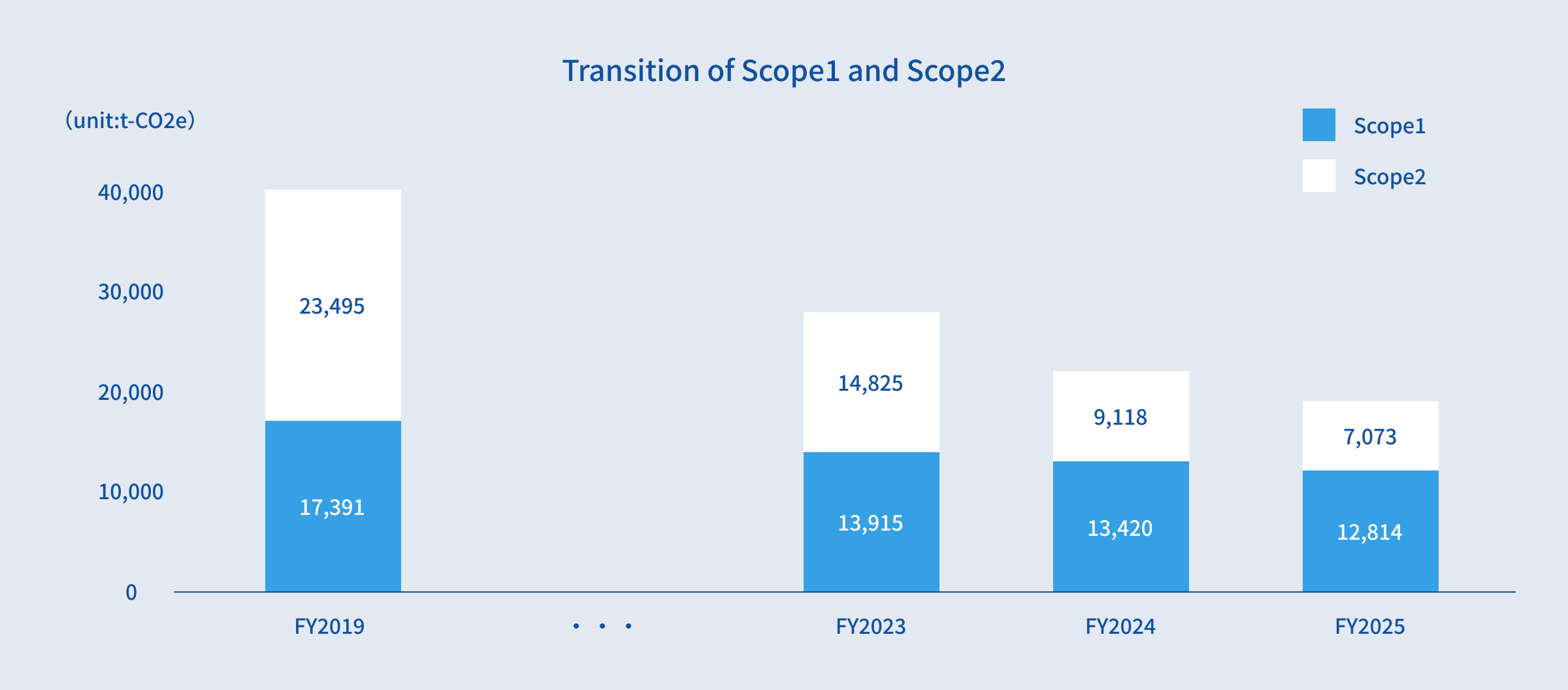
As part of its efforts to reduce its environmental footprint, the Group uses greenhouse gas emissions (Scope 1, 2, 3) as key indexes to identify the fields with large emissions and the targets for reduction. In light of changes in the social environment, the Group had previously set short-, medium-, and long-term targets for reduction and worked toward them for Scope 1 and 2 emissions, which it directly releases. However, reflecting changes in the social environment and its reduction progress to date, the Group established new short-, medium-, and long-term targets in June 2026 looking ahead to FY2030, FY2040, and FY2050. The Group also recognizes that efforts toward Scope 3 are crucial for achieving these targets, and is progressing with considerations toward the formulation of specific reduction targets. Going forward, the Group will work more closely with its suppliers and customers to advance efforts to reduce greenhouse gas emissions.
Greenhouse Gas Emission Reduction Targets and Results
Previous targets
| Metrics | Targets (compared to FY 2019) |
FY2019 (base year) |
|---|---|---|
| Greenhouse gas emissions (Scope1・2) |
|
40,886t-CO2e |
New targets
| Metrics | Targets (compared to FY 2019) |
FY2019 (base year) |
FY2025 (results) |
|---|---|---|---|
| Greenhouse gas emissions (Scope1・2) |
|
40,886t-CO2e | 19,887t-CO2e (reduced by 51.4%) |
Actual Scopes 1, 2, and 3 Emissions *1
| Issue | FY2019 (base year) (19.4~20.3) |
FY2023 (23.4~24.3) |
FY2024 (24.4~25.3) |
FY2025 (25.4~26.3) |
|---|---|---|---|---|
| Scope1 |
17,391 |
13,915 |
13,420 |
12,814 |
| Scope2 (Location-based) |
15,042 |
16,001 |
15,589 |
15,537 |
| Scope2 (Market-based) |
23,495 |
14,825 |
9,118 |
7,073 |
| Scope1 and 2 total *2,3 (Scope 2 is calculated on Market-based) |
40,886 |
28,740 |
22,538 |
19,887 |
| Scope3 *4 |
2,313,075 |
2,106,013 |
1,992,206 |
1,520,156 |
| category1 (Purchased goods and services) |
2,263,257 |
2,086,402 |
1,964,191 |
1,488,437 |
| category2 (Capital goods) |
40,283 |
10,803 |
16,041 |
19,692 |
| category3 (Fuel and energy related activities not included in Scope 1 and 2) |
4,762 |
4,538 |
4,486 |
4,389 |
| category4 (Upstream transportation and distribution) |
438 |
354 |
432 |
406 |
| category5 (Waste generated in operations) *5 |
3 |
18 |
20 |
68 |
| category6 (Business travel) |
623 |
495 |
498 |
390 |
| category7 (Employee commuting) |
2,952 |
2,771 |
5,830 |
6,008 |
| category13 (Downstream leased assets) *4 |
757 |
632 |
708 |
766 |
- *1. Target Organization: TOHO HOLDINGS, TOHO PHARMACEUTICAL, SAYWELL, Kyushu Toho, KOYO, TOHO SYSTEMS SERVICE
- *2. Scope 2 emissions data is calculated on a market basis.
- *3. In calculating greenhouse gas emissions for the current fiscal year, the emission factors for the previous fiscal year (FY2024) were used for certain power suppliers whose FY2025 factors were unavailable as of June 24, 2026. Once the FY2025 emission factors were published by these suppliers, the greenhouse gas emissions were recalculated and disclosed on this website in August 2026.
- *4 In Scope 3 Category 13 "Downstream leased assets," the figures for previous fiscal years have been retroactively revised due to a closer examination and change in the target scope, but there is no significant change in the actual amount of activities.
- *5 In Scope 3 Category 5 "Waste generated in operations," the figures increased due to the strengthening of the data collection system, but there is no significant change in the actual amount of activities.
Future Initiatives
The Group will systematically work on three aspects of the energy issue to help achieve the government goal for carbon neutral. These are saving energy by retrofitting existing facilities and equipment to make them more efficient, creating energy by introducing solar power generation installations, and procuring renewable energy.
Initiatives implemented in FY2025 are as follows:
- Improvement of delivery efficiency through the introduction of delivery planning system and delivery management system
- Installation of own solar panels
- Introduction of EV vehicles and installation of EV charging spots
- Switching the existing electricity plan to a renewable energy plan in logistics centers
- Promotion of ZEB (Net Zero Energy Building) certification for facilities